SELECT Statement in Oracle SQL
The SELECT statement is one of the most important commands in Oracle SQL. It is used to retrieve data from database tables and display specific information based on business requirements.
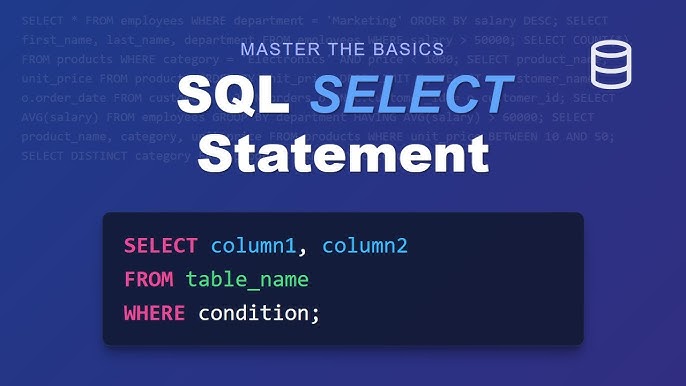


The SELECT statement is used in Oracle SQL to retrieve data from one or more database tables. It is one of the most commonly used SQL commands because almost every database operation starts with reading or viewing stored information. Whether we are checking employee records, viewing product details, generating reports, or analyzing business transactions, the SELECT statement helps us fetch the required data from the database.
In a relational database, data is stored inside tables in the form of rows and columns. The SELECT statement allows users to choose which columns they want to display and from which table the data should be retrieved. For example, if an employee table contains employee names, departments, salaries, and joining dates, SELECT can be used to display all columns or only selected columns depending on the requirement.
The basic structure of a SELECT statement is simple and easy to understand. A user writes SELECT followed by the column names, then uses FROM to specify the table name. If all columns are required, the asterisk symbol can be used. However, in real-world applications, selecting only required columns is considered a better practice because it improves readability and avoids unnecessary data loading.
Basic examples of SELECT statements include:
SELECT * FROM employees;SELECT employee_name, salary FROM employees;SELECT department_id, job_title FROM employees;SELECT product_name, price FROM products;SELECT invoice_no, invoice_date, total_amount FROM invoices;
The SELECT statement is widely used in business applications and reporting systems. For example, an HR department may use it to view employee details, a finance department may use it to check invoice records, and an inventory team may use it to review product stock. Developers also use SELECT statements while building application screens, APIs, dashboards, and admin panels where data must be displayed to users.
Common use cases of SELECT in Oracle SQL include:
- Viewing employee, customer, or product records
- Displaying specific columns from a table
- Preparing reports and dashboards
- Checking transaction history
- Retrieving data for application screens
- Analyzing business information
SELECT can also be combined with other SQL clauses to make queries more powerful. For example, WHERE can be used to filter records, ORDER BY can be used to sort results, GROUP BY can be used to summarize data, and JOIN can be used to combine information from multiple tables. This makes SELECT the foundation for many beginner, intermediate, and advanced SQL concepts.
Understanding the SELECT statement is a major step in learning Oracle SQL. It teaches how data is retrieved from tables and how useful information can be extracted from stored records. Once the SELECT statement is clear, it becomes easier to learn filtering, sorting, grouping, joins, subqueries, and reporting. In simple words, SELECT is the starting point for working with data in Oracle SQL.