WHERE Clause in Oracle SQL
The WHERE clause in Oracle SQL is used to filter records based on specific conditions. It helps retrieve only the required data from a table instead of displaying all records.
The WHERE clause is one of the most important parts of Oracle SQL because it allows users to filter data based on specific conditions. In a database table, there may be hundreds, thousands, or even millions of records. Retrieving all records every time is not practical in real business applications. The WHERE clause helps users narrow down the result and display only the records that match the required condition.
In Oracle SQL, the WHERE clause is commonly used with the SELECT statement. A SELECT statement retrieves data from a table, while the WHERE clause controls which rows should appear in the result. For example, if an employee table contains records of all employees, the WHERE clause can be used to show only employees from a specific department, employees with salaries above a certain amount, or employees hired after a specific date. This makes data retrieval more accurate and meaningful.
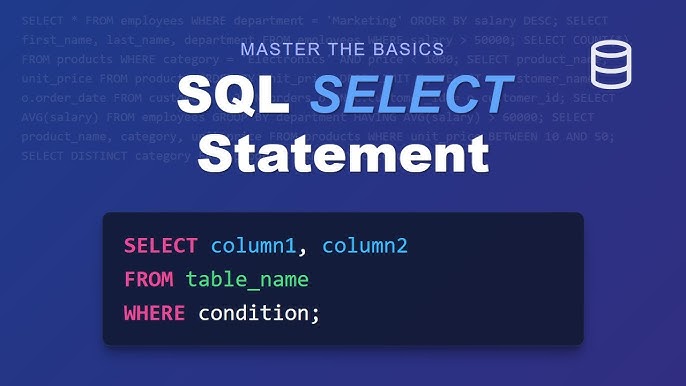
The basic structure of a query using WHERE is simple. First, the required columns are selected, then the table name is mentioned, and after that the condition is written using the WHERE clause. Conditions can be based on numbers, text, dates, or other column values. For example, a business may need to view only active customers, pending invoices, available products, or transactions completed within a selected period. In all these cases, WHERE plays an important role.
Basic examples of WHERE clause include:
SELECT * FROM employees WHERE department_id = 10;SELECT employee_name, salary FROM employees WHERE salary > 5000;SELECT * FROM products WHERE price <= 100;SELECT * FROM customers WHERE city = 'Riyadh';SELECT * FROM invoices WHERE status = 'Pending';
The WHERE clause supports different comparison operators that help create conditions. These operators allow users to compare values and filter records according to business needs. For example, the equal operator can find exact matches, the greater than operator can find values above a limit, and the not equal operator can exclude specific records. These operators are used in almost every real-world SQL query where filtered results are required.
Common operators used with WHERE include:
=equal to!=or<>not equal to>greater than<less than>=greater than or equal to<=less than or equal toBETWEENfor range-based filteringLIKEfor pattern matchingINfor matching multiple values
The WHERE clause is widely used in enterprise systems such as HRMS, ERP, finance, healthcare, inventory, and sales applications. In an HRMS system, it can filter employees by department or job title. In an inventory system, it can show products with low stock. In a finance system, it can display unpaid invoices. In a healthcare system, it can retrieve patient records based on visit date or department. This makes WHERE one of the most practical SQL concepts for daily database work.
Understanding the WHERE clause is essential for writing useful Oracle SQL queries. Without WHERE, queries may return unnecessary data, making reports difficult to read and applications slower. By using WHERE correctly, users can retrieve accurate, focused, and meaningful results from large database tables. It is a key concept that prepares learners for advanced filtering, logical operators, joins, reporting, and real-world SQL problem-solving.